Showing posts with label ferrari. Show all posts

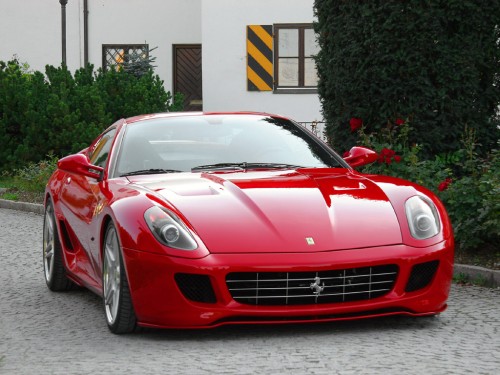
Ferrari 599 GTB Fiorano

Ferrari 599 GTB Fiorano

The 599 is a Grand Touring car from Ferrari that combines svelte looks with superb handling AND outrageous performance in a way none of the previous cars on the list could do. It is also the most powerful street car Ferrari has ever produced, with 612 HP at the flywheel, and features an “F1 Superfast” sequential manual gearbox that changes gears faster than most of us can blink. And while the 599 will no doubt prove to be another classic from Maranello, the car’s technological innovations, at least at this point, make its spec sheet more praiseworthy than the car itself.

The Experimental HY-KERS Hybrid vehicle

Ferrari at Geneva: protagonists in innovation and the environment

The Experimental HY-KERS Hybrid vehicle


The Experimental HY-KERS Hybrid vehicle


The Experimental HY-KERS Hybrid vehicle


The Experimental HY-KERS Hybrid vehicle

Geneva, 2 March - The HY-KERS vettura laboratorio (experimental vehicle) is an example of how Ferrari is approaching the development of hybrid technology without losing sight of the performance traits and driving involvement that have always exemplified its cars.

This hybrid project is also aimed at ensuring that Ferrari will be in a position to comply with future CO2 emissions standards, particularly in terms of the urban cycle. City driving is traditionally where sports cars are most penalised as their engines are designed for maximum efficiency and performance at high revs, whereas the urban cycle involves low revs and low engine loads.

Ferrari has employed its racing experience to adapt an advanced, lightweight hybrid drivetrain to the 599 GTB Fiorano with the aim of ensuring that vehicle dynamics are unaffected. This was achieved by the careful integration of all system components, positioning them below the centre of gravity and ensuring that interior and luggage space are entirely unaffected. Similarly the flat lithium-ion batteries are positioned below the floorpan. The result is a centre of gravity that is even lower than in the standard car.

Ferrari has also applied its F1 technology to the design, engineering and construction of a new kind of electric motor which helps optimise the longitudinal and lateral dynamics of the car, enhancing traction and brake balance. The motor also features a unique cooling and lubrication system for maximum efficiency under all operating temperatures and loads.

Weighing about 40 kg, the compact, tri-phase, high-voltage electric motor of the HY-KERS is coupled to the rear of the dual-clutch 7-speed F1 transmission. It operates through one of the transmission’s two clutches and engages one of the two gearbox primary shafts. Thus power is coupled seamlessly and instantaneously between the electric motor and the V12. The electric motor produces more than 100 hp as Ferrari’s goal was to offset every kilogram increase in weight by a gain of at least one hp.

Under braking the electric drive unit acts as a generator, using the kinetic energy from the negative torque generated to recharge the batteries. This phase is controlled by a dedicated electronics module which was developed applying experience gained in F1 and, as well as managing the power supply and recharging the batteries, the module also powers the engine’s ancillaries (power steering, power-assisted brakes, air conditioning, on-board systems) via a generator mounted on the V12 engine when running 100 per cent under electric drive. It also incorporates the hybrid system’s cooling pump.

This experimental vehicle thus maintains the high-performance characteristics typical of all Ferraris while, at the same time, reducing CO2 emissions on the ECE + EUDC combined cycle by 35 per cent.

Ferrari California Stop&Start

The other important novelty at the Geneva Show is again aimed at reducing emissions. From March 2010 in fact the Stop & Start system will be available on the Ferrari California, reducing fuel consumption and CO2 emissions by 6 per cent in the ECE + EUDC combined cycle. This means a figure of 280 g/km, one of the most competitive of any high-performance cars. The Stop & Start cuts in virtually instantaneously - just 230 milliseconds, a time so fast that the driver barely notices the engine restarting.

This solution is a further step in Ferrari’s on-going strategy to reduce fuel consumption and emissions, even when increasing performance. One of the principal areas of research has been dedicated to reducing friction within the engine. The Ferrari California’s direct-injection V8, for example, has eliminated the ‘pumping’ losses created by the changes in pressure below the pistons. Inserting purge valves in the crankcase below the crank throws allows blow-by gas and oil compressed during the combustion phase to leave the crankcase without being drawn back in during the compression phase. This ensures a direct increase in engine efficiency.

In addition DLC (Diamond Like Carbon) coatings on the valve followers and superfinishing of the cam lobes reduces friction in the valve train and contributes to the overall improvement in engine friction.

Self-sufficient with green power in Maranello

In keeping with Ferrari’s 360-degree approach to efficiency and its commitment to environmental sustainability, new technologies for its road cars are matched by the considerable investments already made to reduce the environmental impact of the company’s production activities in Maranello.

After the inauguration of the photovoltaic installation on the roof of the Mechanical Machining facility in January 2009, which reduced the factory’s power requirements by over 210,000 kWh annually, 2009 also saw the opening of Italy’s biggest trigeneration plant (the simultaneous production of power, heat and cooling from a single source) – the first of its kind to be implemented by a sports car manufacturer. Combined, the two systems reduce CO2 emissions by 30,000 tons a year (40 per cent). Thanks to these ecological solutions, Ferrari is completely autonomous for its energy requirements. This reduction also means that Ferrari will meet the Kyoto protocol objectives a full 10 years ahead of schedule and with double the figure imposed on Europe.

This represents another significant step forward in the ‘Formula Uomo’ strategy implemented by Ferrari’s Chairman, Luca di Montezemolo, at the end of the 1990s and which has transformed the Maranello production facility into one of the most advanced in the world. It has also helped create a unique working environment which, in addition to other initiatives for the well-being of employees, ensures that Ferrari has become a model, as demonstrated by the fact that the factory has, in the past, received the ‘Best Place to Work in Europe’ award.

copy from: ferrari.com

Ferrari F500

2010 ferrari f500
U.S Auto magazine Car and Driver has published a  rendering of the 2010 Ferrari F500. The Ferrari F500 will be an updated F430 with a larger and more powerful engine. A V8 5000cc engine brings out 550hp gets filtered through a 7-Speed dual clutch gearbox for continuous power supply.
The 2010 Ferrari F500 will fight for the crown of the best supercar against the likes of the Mclaren P11, Lamborghini LP560-4 and the Porsche 911 GT2.
Scuderia and convertible variants will don a higher price tag when they are introduced subsequently, but the base Ferrari F500 that will be shown of at this year’s Frankfurt Motor Show will start at $200,000.

Ferrari 599 GTO

Ferrari 599XX shown for comparison
Is the legendary “GTO” badge set to make a comeback at Ferrari? While rumors of a new GTO have been circulating for awhile, EVO seems to think it’s a done deal. The magazine is reporting that Ferrari has shifted the 599 GTB Fiorano from its internal “GT” classification to the “Sports Car” division, signaling a change that will allow the “development of a more extreme version of the 599, much in the same way that the Scuderia was developed from the standard F430.”
The 599 GTO would essentially be a street version of the 599XX track special, with a whopping 700 horsepower coming from its Enzo-based 6-liter V12. Using the company’s 599 HGTE as a benchmark, the 599 GTO would offer even better handling and performance that could conceivably make this Ferrari’s fastest road car ever. Evo is predicting a 0-60 time of 3.2 seconds and a top speed that would eclipse the Enzo’s 217 mile-per-hour V-max.
If the speculation is true, this would be the first Ferrari to wear the “GTO” name since the F40-preceding 288 GTO went on sale in 1984. The “O” in “GTO” stands for “Omologato,” a designation used for street cars that are being sold to homologate the model for racing. It was most famously used on the 1962-1964 Ferrari 250 GTO, which did battle with the Shelby Cobra in FIA GT racing back in the day. It was revived on the 288 GTO when Ferrari decided to build a model for the ill-fated Group B racing class. With only the Porsche 959 as a challenger the class was disbanded and the 288 GTO never raced.
Labeling this new supercar a 599 GTO would seem to imply that Ferrari was planning to race the vehicle, but exactly where it would compete is a mystery. Still, Evo is reporting that 50 of the vehicles will be built and sold in the UK, priced at £300,000 apiece. That’s the equivalent of $480,000 at the current exchange rate. Deliveries could start as soon as May of this year.

ferrari walpaper

red ferrari
sexy ferrari
hot ferrari
sports ferrari car

Ferrari Calavera

 Ferrari CalaveraFerrari Calavera
Ferrari CalaveraFerrari Calavera


The Ferrari F430 is on its way out, making way for its replacement tipped to debut at the Frankfurt show. Ferrari itself is saying goodbye with a special edition to be auctioned off for charity, but a pair of German firms has collaborated to send off the F430 in its own unique brand of style. A joint effort by a company called Unique Sportscars and the Novitec Rosso tuning house we've come to know for its turbo- and supercharged Prancing Horses, the F430 Calavera seems to answer questions nobody was asking, namely, what would a Ferrari look like if it spent too much time on Venice Beach? Well here you have it.

Ferrari F430 Calavera comes with an airbrushed exterior prominently boasts a large skull on the hood, darkened taillights, tinted windows, and 20-inch wheels. The interior also gets a modest makeover with embroidered seats, an elongated center console, and iPod connectivity. The Calavera is powered by a twin-supercharged version of Ferrari’s 4.3-liter V8 engine which produces 707 horsepower and 712 Nm of torque. The Ferrari F430 Calavera rockets from 0-100 km/h in 3.5 seconds before hitting a top speed of 348 km/h (216 mph). Unique Sportcars Ferrari F430 Calavera also comes with other performance kits include a Novitec Rosso front spoiler and rear wing, revised gear ratios, and a lowered sports suspension.

Ferrari F430 engine


The F430 is powered by a new 90 degree V8 featuring Ferrari's traditionally uncompromising design approach with a flat-plane crank (180 degrees between throws).
This is an all-new unit that does not share any components with the 360 Modena's engine. The improvement in terms of performance, weight and reduction of overall dimensions is the result of applying Ferrari's wealth of F1 experience to its road cars.Despite a 20% increase in engine displacement (from 3586cc to 4308cc), engine weight has increased minimally (just 4kg), while performance is considerably improved. Torque increases by 25% (343lb.ft at 5250rpm, 80% of which is already available at 3500rpm) and power by 23% (490bhp at 8500rpm).
The engine is extremely compact with a cylinder spacing of just 104mm. Similarly, Ferrari's engineers integrated the sump and main bearings in a single casting which, along with a smaller diameter twin-plate clutch and flywheel, has reduced theengine height between the bottom of the oil sump and the crankshaft to just 130mm (from 145mm on the 360 Modena power unit).
In line with the latest developments in high specific output engines, there are new 4-valve cylinder heads, and the inlet tracts and valve diameters are derived directly from designs used on the F1 engines.The twin overhead camshafts per cylinder bank feature continuously variable timing on both inlet and exhaust cams, and hydraulic tappets drive the valve gear. Actuation of the variable valve timing is guaranteed by a high-pressure hydraulic system (20bar), obtained by using a supplementary pump, an external accumulator and a circuit that works in parallel with the oil circuit for the hydraulic tappets.
This ensures that a full timing cycle is completed in 0.1 seconds. Ferrari has dropped the mixed gear/toothed belt distribution system for a chain-driven system, thus reducing the overall length of the engine. Crankshaft, con rods and pistons are also all new.


Ferrari F430


It offers a better weight distribution of the car, between the front and rear of course. Also it most importantly offers less horsepower loss when transferring that power from the motor, through the drive-train, to the wheels. To elaborate on that, in a front motor/rear wheel drive application, the power the motor creates has to travel a longer distance through the motor to the driveshaft that connects to the rear wheels and in turn spins the wheels. With a mid engine set up it travels a way shorter distance to the rear wheels.

Ferrari Enzo.


Super cars costing $ 1,000,000 (the auction). Formula 1 technology, the body of the Carbon Fiber, even using technology that is not permitted used in Formula 1, such as Aerodynamics and Active Traction Control.

Novitec Rosso


Tuner ABT Sportsline made recent moves through the Audi TT Roadster Series. Two-door sedan that had undergone surgery and managed to attract the attention of automotive enthusiasts from around the world. Not only to make history and the latest record of engine speed and capacity but also managed to carve figures to 420 horsepower when tested in rally racing. House party modifications ensure that this made the car an icon from the manufacturer usually called the ur-Quatro.
Hoping to return to repeat past glory when the Audi was in the top 1980'an success diear years. The concept that evolved through the engine from the sedan is covered with the white color has the ability beyond the standard limits. Audi TT-RS is relying on the five-cylinder engine. Thanks to the concoction created by the tuner capable of increasing power by 80 horsepower.
Original standard capacity machines owned manufacturer only 340 hp, one of the efforts made by the tuner that combines with the water cooler machines and electronic systems as well located on the engine. The result was not in vain, for the perfection achieved acceleration from 0-100 km / h takes just 4.3 seconds. While the ability of the machine can be sped up to a maximum limit of 282 kim / h. Not much has changed from other sectors, most of the design of cars still represent the original form of the manufacturer.

Ferrari 599 GTB Fiorano


599 GTB Fiorano China Limited Edition only made one unit. One of the uniqueness of this car lies in the exterior where the touch was given bodinya Rosso Fuoco two colors with a silver roof and character design eleman China.
Not only that, Ferrari-style blend is also Ge Kiln ceramic China Song Dynasty from 599 GTB on the body. The shape of the image cracks typical ceramic China.
Ferrari said the country's only remaining hundreds Ge Kiln Porcelain in the world. For a typical ceramic cracks Ferrari China gives its own meaning for a force.
"China Fiorano 599 Limited Edition is a true masterpiece. This car breaks historic cultural heritage of China with Italian design is spectacular, "said Ferrari's Asia Pacific CEO Marco Mattiacci.